
What is Ayurveda?
Ayu means life and Veda means knowledge, and so Ayurveda is often referred to as the “Science of Life” – however it is more an instruction for enhancing life and is both a living system of Ayurvedic medicine and one of the oldest continuously practiced in the world. Ayurveda is the traditional holistic health system in India and is more than 5,000 years old. It uses a constitution based model (the doshas) for determining your state of health and works as a form of mind-body medicine.
Thousands of years ago, India’s Rishis and seers observed the rhythms of the universe and the interaction of the flow of energy throughout the body/mind during deep states of meditation – these insights form the basis of Ayurveda and were documented in ancient Indian texts such as the Charaka Samhita.
Read more
Digestion
The Ayurvedic perception of digestion is summed up in the term ‘Jatharagni’. In the simplest possible sense this can be interpreted as ‘Digestive Fire’ (Jathar = the digestive tract ; Agni = fire). When it is working well it has an enzymatic type of action, whereby the processing of foods is complete and the metabolism is balanced, ensuring the efficient working of all the body systems.
However, if the agni is weak this results in the production of ama (toxic waste).
Read more
Ama
In Ayurveda ama implies anything that is in a state of incomplete transformation. Specifically, in Ayurvedic treatment, it refers to a toxic by-product of improper or incomplete digestion.
Read more
Daily Routine
Ayurveda credits a consistent daily routine with maintaining balanced physical, mental and emotional health. According to their body type, seasonal and environmental factors, a person can avoid illness by implementing regular habits that span from morning to evening. When one performs these habits creating a healthy lifestyle, the body falls into its natural biorhythms and biological patterns. For example, if one wakes at sunrise, their body will align with sun energy which helps to balance and regulate their metabolic system.
Read more
Food as Medicine
We constantly refer to the importance of diet in the Ayurvedic approach to treatment. There can be occasions where herbal medicine is not considered appropriate, such as interaction with other medications, or simply in the case of aversion. At such times, an
Ayurvedic diet itself can become the medicine.
The Story of Ganesha
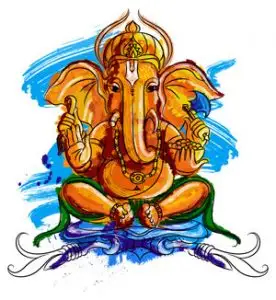 In Indian mythology Ganesha is the God of Wisdom, the Lord of Success and the Remover of Obstacles. He has the head of an elephant and the huge pot-belly of a human.
Read more
Ayurvedic Preparations
Ayurvedic medicine are made from a combination of many herbs and minerals. Traditional Ayurvedic herbs are those native to the Indian subcontinent – Raman Das formulates a blend of these Indian herbs according to your needs after consultation.
Ayurvedic medicine and supplements are traditionally classified as being for Vata, Pitta or Kapha imbalances, and often one type of preparation is able to treat many disorders. One example is medication for sinus problems, which also works for digestion, influenza, headache, and general vitality. When Pitta is low then Fire (Agni) is low, and toxic substances start to accumulate in different channels of the body due to low metabolic rate. This creates congestion in the flow of energy in the different channels. When this occurs, blockage of the mind, no willpower, no inspiration, depression, anxiety, all sorts problems can result.
Introduction to Yoga

Yoga is an ancient system of Hindu philosophy from India, and means union, co-ordination, harmony, balancing of mind, body and spirit. There are six Vedic philosophies of life, and among them two are about yoga – Sankhya yoga, and Patanjali yoga.
Sankhya yoga describes the origin of the universe, mind, body and spirit in great detail and is more theoretical in nature. It is very helpful in understanding the mystery of and different elements of the universe, and it also describes the function of sense organs, previous life, after death, birth and the universal cosmos.
Patanjali yoga explains the detailed philosophies and practice of the yoga system. This system is most popularly recognised as Yoga these days. The Classical text of this system is found in the form of aphorisms. Every aphorism of the Patanjali yoga sutras has a vast and complex meaning. This text describes eight steps of the yoga system:
Read more
Latest Research
Please enjoy the latest information on the fields of Ayurveda and Yoga: